
Q & A with Violin Soloist Siwoo Kim
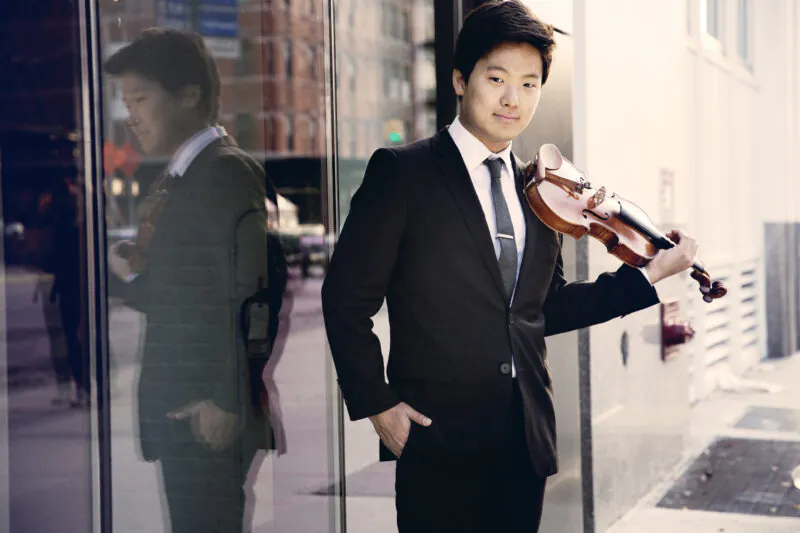
Renowned violinist Siwoo Kim is the featured soloist for the Vivace Baroque Orchestra at our upcoming Vivaldi and Piazzolla concert on May 17 at The Mahaiwe.
Siwoo is an “incisive” and “compelling” violinist (The New York Times) who “plays with stylistic sensitivity and generous tonal nuance.” (The Chicago Tribune) He is the founding co-artistic director of VIVO Music Festival in his hometown of Columbus, Ohio.
Read Siwoo Kim’s full bio here.
We hope you enjoy Siwoo Kim’s thoughts on Vivaldi’s The Four Seasons and Piazzolla’s Four Seasons of Buenos Aires. You’ll also learn a bit about his 2008 Joseph Curtin violin.
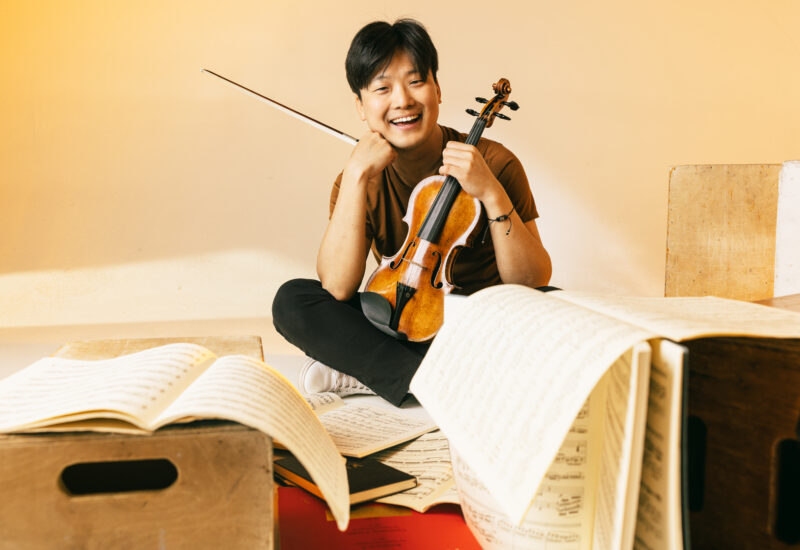
About The Four Seasons
Q. The Four Seasons is so familiar—how do you approach it in a way that feels genuinely new rather than inherited?
A. Every musician has their own unique physique, taste, background and philosophy that informs their interpretation and sound. In my preparation, I am approaching the score from a blank slate while being what I deem to be honest. Multiply that by the entire orchestra, and we have ourselves a kaleidoscopic cocktail of output. I can’t wait to start rehearsing and exploring with everyone!
Q. Vivaldi’s concertos are tied to specific imagery. Do you think of yourself as telling a story, or creating something more abstract?
A. Having grown up loving visual arts, I appreciate Vivaldi’s programmatic imagery. Often, there is no true storyboard; rather, evocations. I take inspiration from the text to try to heighten Vivaldi’s playful intentions with sound.
Q. Why do you think Vivaldi continues to top the charts centuries later
A. Good question! Perhaps the accessible ear worms, friendly duration, virtuosity and memorable title. It’s also quite programmable, even in a small town, since the forces required to bring it to life are not astronomical. I think the set stands out among the 230 violin concertos he composed because it invites people to open up their imagination revolving around shared, human experiences as its thematic material.
Q. What shifts most radically for you when moving between Vivaldi and Piazzolla in the same program?
A. This is actually the first time I am performing both sets in one concert. In preparation, I am shifting my “voice” most radically. The sonic landscape of Vivaldi is lean and precise whereas for Piazzolla, there is room for more depth, grit and sensual rubato – the Desyatnikov arrangement is based heavily on Piazzolla’s own performance of the Four Seasons of Buenos Aires on bandoneon, right down to his raw improvisation and timing.
Q. Piazzolla’s language is rooted in tango—how do you inhabit that style without it feeling like an imitation?
A. It is tango MUSIC so essentially rhythm forward. All musical languages are universal and empathetic while appealing to our primal minds and souls. For this task, I am an actor, and I am studying Piazzolla’s own performance and temperament quite carefully. I take inspiration for my sound/voice (both consonants and vowels) from the Spanish language and one of my favorite works by Piazzolla, “Maria de Buenos Aires.”
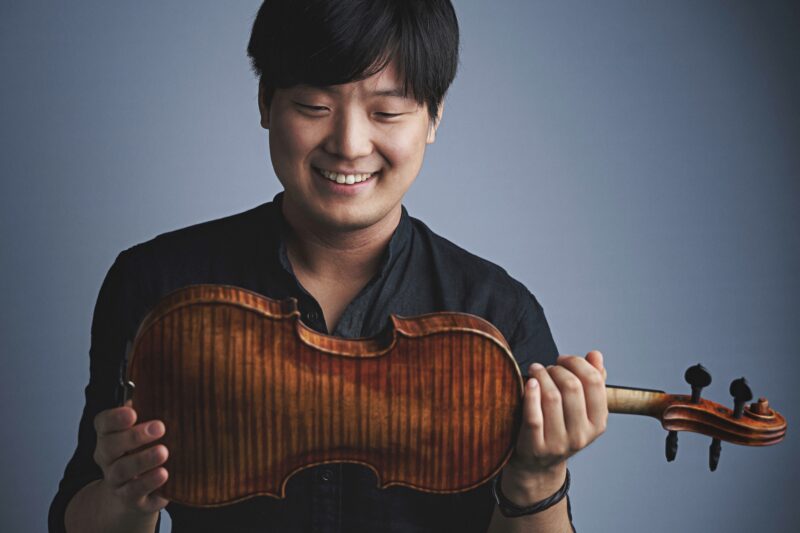
About Siwoo’s Violin
Q. Can you tell us about the violin you play—its maker, history, and how it came into your life?
A. I play on a violin by Joseph Curtin from 2008. It is the first full-size violin I own. I was on loans of older instruments since I was 12 years old. Almost three years ago, I decided it was time to get “married.” The fancy instruments I “dated” informed what I look for in an instrument, and this is the best violin within my budget that I found. It was previously owned by Ilya Kaler and then Angelo Yu. It has been a joy getting to know each other, and it bats way above its league!
Q. What is unique about this instrument’s voice, and how does it shape your interpretation?
A. My violin has a very shiny, “sizzly” upper register and a deep, boomy lower register. It is quite powerful but very responsive. It gives me a large range of timbre and tone color to play around with, thus giving me the freedom to explore different interpretive choices without restriction or trepidation about projection.
Q. Does this violin respond differently to Vivaldi versus Piazzolla?
A. It does what I tell it to do! 🙂