Tag Archive for: Yehuda Hanani

“How do I love thee? Let me count the ways.” To Robert Burns, love is like a red, red rose. Shakespeare compares it to a summer’s day. Love is one of the great themes in all civilizations, and variations inn music are the many ways of loving a theme—by embellishing it, elaborating on it, allowing it to veer out and experience a full range of possibilities and directions.

Themes and variations exist not only in music. Painters, novelists, and poets fix their interest on a theme, and then they patiently study it. They take it apart, put it under a microscope, look at all its components, and transform it.

Claude Monet was compelled to come back repeatedly to the cathedral in Rouen and paint it again and again as it changed nuances with the seasons and with the time of day. Each of his renditions of the cathedral is a new revelation—a new variation.

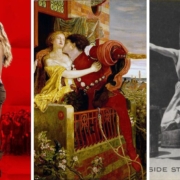
According to Leo Tolstoy, history has only two great themes—War and Peace. In all of literature there are maybe thirty great themes—the theme of Hamlet, the avenging son…Faust, making a pact with the devil for power, money…Or consider Romeo and Juliet, which metamorphoses into Black Orpheus in film, and West Side Story on Broadway—geographic and cultural variations on the theme of doomed love or star-crossed lovers. Take inventory of all the jokes you’ve heard recently, and they probably boil down to a few dozen prototypes with slightly different punch lines!

The construction of theme and variations is a process of abstraction. The composer presents a borrowed theme or his own, traditionally an eight-bar bouquet, and then proceeds to take it apart, petal by petal. He may speed it up, slow it down, invert it, and vary rhythmic patterns, melodic gestures or harmonic progressions. The variations will start close to the theme and then draft away from it, becoming less recognizable and gradually more fantastic and imaginative. At the climax, there is usually a slow variation—often in a minor key—and then the journey homeward begins. The theme, which has been through a series of adventures like the picaresque heroes Don Quixote, and Peer Gynt, reappears, wiser and with more self-knowledge. Having embarked on the same journey, we, too experience the theme differently upon its return. When we speak about the returning of theme in music, we leave behind scientific time, which moves evenly forward, and enter the realm of metaphysics, where time flows freely and turns elliptically back to its source.

Apart from the use of the form for grand or monumental works (the Goldberg Variations by J.S. Bach, Beethoven’s Diabelli Variations, or Brahms’s Variations on a Theme by Handel), it proved ideal for an entertainment genre—a light class of works based on popular songs or arias from operettas and plays. The variations provided the easy pleasure of recognition; and once a tune succeeded in catching the public ear and heart, publishers were eager to cash in on it and encourage composers (great and lesser ones) to write variations on it.

Mozart wrote a set for the old popular tune “Ah, vous dirai-je maman,” or the “ABC” song. In this case, the theme remains intact and is dressed up in various costumes, much like a child dressing a doll in different clothing or using different crayons for the same page of a coloring book. In elaborate cases like the Goldberg, the variations are progressively more removed and the exploration much more adventurous.

Beethoven similarly composed variations on “Rule Brittania” and “God Save the King.” To please the public and increase his income he used two potboilers, a rather silly ditty “I am the Tailor Cockatoo” from the light opera The Sisters from Prague by Wenzel Müller; and a rakish tune from L’Amor Marinaro—translated “Love the Sailor.” This rather crude but catchy melody was so popular that numerous composers published their variations on it. To this list, Close Encounters had added a new one by Paul Schoenfield, which premiered in our 2013 concert season. From L’Amor Marinaro to Beethoven Trio Opus 11 to Shaatnez for Ady by Schoenfield, our theme traveled the high seas and landed I the 21st century in the Berkshires, thanks to the generous patronage of Mark Berger and Bonnie Berger Leighton.

In a deeper sense we are all endless variations on the theme of a human being (there’s a blueprint up there, of which we are all approximations); and just like music, we happen in time, which makes music a mirror of our existence.

In essense, all music (all Western music) is variations on the scale. As a child, I had a moment of epiphany during chamber music coaching with Emile Hauser, the founder of the Budapest Quartet. He was quite old and could not play the violin anymore. Between movements, he sat at the piano and with a trembling hand and with a sense of wonder on his face he played a C major scale. It struck me that as he was nearing the end of his journey, he was summing up his life in music and all the myriad pieces he performed by returning to the theme—from C to glorious C.

By Yehuda Hanani, Artistic Director, Close Encounters With Music

Sewing machine heiress takes Paris by storm, befriends cultural luminaries, and inspires (and supports!) new works by Ravel, Debussy, De Falla, Milhaud, Boulanger, Chabrier, Reynaldo Hahn, and Stravinsky

The daughter of sewing machine industrialist Isaac Merritt Singer, Winnaretta Singer-Polignac was a force of nature, hosting everyone from Leon Bakst to Jean Cocteau and Jean Giraudoux to Prokofiev, Madame Jean Lanvin, Siegfried Wagner, Arthur Rubinstein, Arnold Schoenberg, and Edith Wharton in her Paris salon. More importantly, she was responsible for developing a new genre: “Great music for a small space by up-and-coming composers” in the words of Sylvia Kahan, her biographer, who will join for the four-hand piano “Bagatelle” by Winnaretta’s husband, Edmond de Polignac.  Works either commissioned by her, dedicated to her, or that were performed in her mansion on Rue Henri-Martin, will be featured in this on-stage “salon”: Ravel’s Pavane pour un enfant défunte, Stravinsky’s Piano Sonata 1924, the sizzling César Franck Piano Quintet and songs by Fauré, Poulenc and Reynaldo Hahn. Winnaretta also befriended Marcel Proust and his lover Hahn, who reciprocated with an evening at their Paris salon, inspiring a chapter in Swann’s Way.  The program is a rich tapestry in search of a certain time, place and fascinating personages.

A tantalizing Berkshire connection to the tale of the Princess is that her father Isaac Merritt Singer’s business partner was Edward Clark, a wealthy lawyer who took charge of the manufacturing end of the business, turning it into a major success. The rest is history as Clark’s grandson Robert Sterling Clark and his wife Francine founded the Clark Art Institute in Williamstown to house their personal art collection, much of it acquired on their trips to France.

Artists: Alexander Shtarkman, piano; Sylvia Kahan, piano; William Ferguson, tenor; Xiao-Dong Wang, violin; Grace Park, violin; Helena Baillie, viola; Yehuda Hanani, cello 

TICKET INFORMATION

Single Tickets, $55 (Orchestra and Mezzanine), $30 (Balcony) and $15 for students, are available through the Mahaiwe Performing Arts Center or by calling 413-528-0100. 

“CEWM patrons have learned that sooner or later they’ll be blindsided by a performance so sublime it will defy explanation.”

—  The Berkshire Edge

HOW TO REACH US

Close Encounters With Music

Post Office Box 34

Great Barrington, MA 01230

Web: cewm.org

e-mail: [email protected]

If you don’t already, please follow us on social media! We work to keep our posts informative and inspiring. Facebook: @closeencounterswithmusic and Instagram: @closeencounterswithmusic

NEXT UP

L’Amour Toujours and A World Premiere 
Sunday, June 8, 2025 4 PM
Mahaiwe Performing Arts Center

It’s all about love: A new work for clarinet trio by composer Seth Grosshandler that celebrates young love, courtship and the serendipity of meeting one’s intended receives its inaugural performance.  Signature love arias from favorite operas and Broadway sung by Metropolitan Opera soprano Danielle Talamantes and Kerry Wilkerson.  Schubert’s Shepherd on the Rock (“My sweetheart dwells so far from me, I long hotly to be with her over there”) is a tour de force meshing clarinet and soprano.  Resolved to retire, in 1891 Brahms encountered the clarinet playing of Richard Mühlfeld and was inspired by a fresh muse to compose once again. A scholar and close friend of Brahms praised the Clarinet Trio, writing that “It is as though the instruments were in love with each other.” 

Artists: Max Levinson, piano; Alexander Fiterstein, clarinet; Danielle Talamantes, soprano; Kerry Wilkerson, baritone; Yehuda Hanani, cello

2024/2025 Current Season 

Sunday, October 20, 4 PM, The Mahaiwe Performing Arts Center
Drama and Melodrama – The Schumanns

Sunday, December 15, 4 PM, The Mahaiwe Performing Arts Center
Vivace Chamber Orchestra: Tchaikovsky, Grieg, Boccherini, Barber

Sunday, February 23, 4 PM, Saint James Place
6 Unaccompanied Bach Suites for Cello with Colin Carr & Yehuda Hanani

Sunday, March 23, 4 PM, Mahaiwe Performing Arts Center
”Rite of Spring” – Rachmaninoff/Stravinsky 

Sunday, April 27, 4 PM, Mahaiwe Performing Arts Center
Classical Roots, Latin Soul – The Dalí String Quartet

Sunday, May 4, 12 PM – Private Club, Lenox MA
Luncheon Musicale 

Sunday, May 18, 4 PM, Mahaiwe Performing Arts Center
“A Tale of Two Salons” – Winaretta Singer and Marcel Proust

Sunday, June 8, 4PM, Mahaiwe Performing Arts Center
L’Amour Toujours and a World Premiere

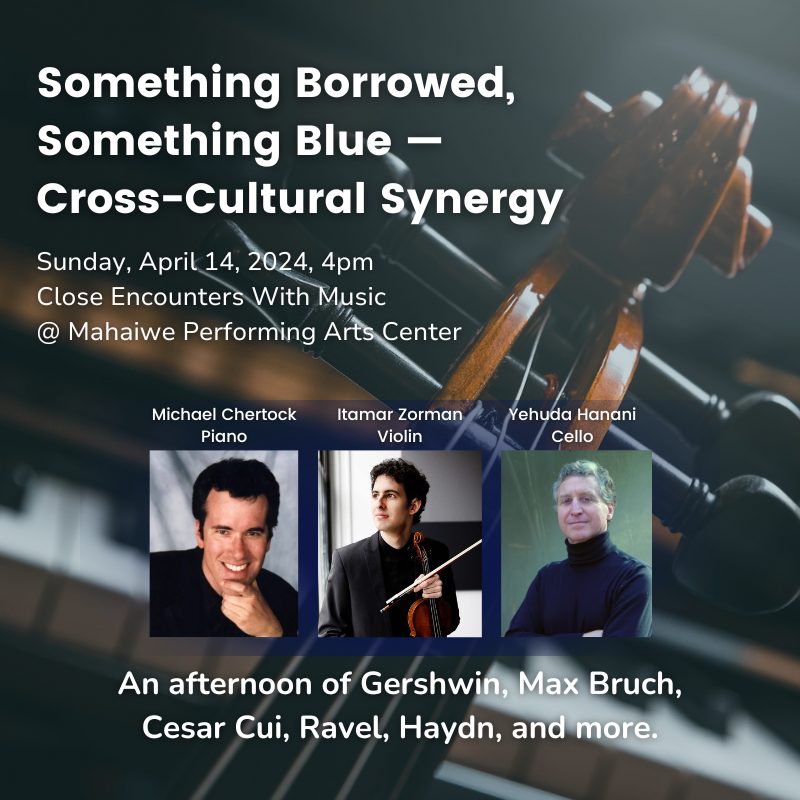
Close Encounters with Music presents “Something Borrowed, Something Blue — Cross-Cultural Synergy” on Sunday, April 14 at 4pm at the Mahaiwe Performing Arts Center, Great Barrington, Massachusetts. Chertock and Zorman join internationally renowned cellist and artistic director Yehuda Hanani for an adventurous musical voyage. Join us for this intriguing chamber music performance!

Debussy and Ravel in Spanish attire; Haydn’s “Gypsy” Trio, Beethoven Turkish Marches, Synagogue Prayer in Gregorian Mode, Tango, and Other Exotica Enliven and Extend the Composers’ Palettes and Listeners’ Pleasures.  And Celebrating 100th Anniversary of Gershwin’s 1924 Rhapsody in Blue!

Press Release

Close Encounters With Music’s Winter / Spring 2024 concerts continue on Sunday, April 14 with an afternoon of jazz, tango, liturgy, waltz, Habanera and Gershwin’s wildly popular Rhapsody in Blue, known for its integration of jazz and classical music – and written on the train between New York and Boston!  Composers include Haydn (Gypsy tunes), Max Bruch (German composer retrofits synagogue “Kol Nidrei” prayer), Ravel and Debussy (Spanish and North African heritage), César Cui (Russian composer writes “Orientale”), and Astor Piazzolla (tango goes to Paris!).     

Michael Chertock, piano; Itamar Zorman, violin; Yehuda Hanani, cello.

Pianist Michael Chertock has been a soloist with the Philadelphia Orchestra, Orchestre Symphonique de Montréal, the symphony orchestras of Toronto, Baltimore, Detroit, Utah and Oregon, and made his Carnegie Hall debut with the Cincinnati Pops.  Since his emergence winning top prize at the 2011 International Tchaikovsky Competition in Moscow, violinist Itamar Zorman has wowed audiences all over the world with his breathtaking style, causing one critic to declare him a “young badass who’s not afraid of anything.”  Also winner of the 2013 Avery Fisher Career Grant, he has performed as soloist with such orchestras as the Israel Philharmonic, New World Symphony, Saint Paul Chamber Orchestra, Atlanta Symphony, German Radio Philharmonic, and RTE National Symphony Orchestra (Dublin), working with Zubin Mehta, Michael Tilson-Thomas, David Robertson, Valery Gergiev, Karina Canellakis and Yuri Bashmet.  Chertock and Zorman join internationally renowned cellist and Artistic Director Yehuda Hanani in “Something Borrowed, Something Blue—Cross-Cultural Synergy” for an adventurous musical voyage.

Read artist bios here.

CEWM has resumed its hors d’oeuvres and wine Afterglow receptions on stage following the concerts. Audience members are invited to meet the artists and enjoy beverages and bites by Authentic Eats by Oleg. Join us!

TICKET INFORMATION 

Tickets, $52 (Orchestra and Mezzanine) and $28 (Balcony), can be purchased at www. cewm.org or by calling 413-528-0100. We also offer a virtual option—tickets are $28 for individual programs, delivered to your email address!

Tag Archive for: Yehuda Hanani

How to end and exit a musical composition—with a bang or a whimper? Will there be the thunderous affirmation of a Beethoven symphony or a whispered adieu à la Mahler’s Song of the Earth, sailing into eternity? A cliffhanger ending leaves the audience on the edge of their seats while a full-circle ending bringing us back to the beginning satisfies human desire for resolution and completeness. Ambiguous endings can evoke many different emotional responses while the happy ending is a classic, satisfying viewers and listeners as they wrap up their experience. Compositional choices will be illuminated by Shostakovich’s haunting, riveting Trio No. 2 and Schubert’s heavenly last work, the Trio No. 2 in E-flat major (the main theme of the slow movement was borrowed from a Swedish song, “The sun has set”), as he turns death and personal tragedy into a triumph—his own personal ending of choice.

Gila Goldstein, piano; Xiao-Dong Wang, violin; Yehuda Hanani, cello

Buy Tickets Button


Individual Tickets: Orchestra/Mezzanine: $60

Season Subscriptions

  • Early Bird Subscription Deadline: September 28
  • Early Bird Subscribers will receive their e-tickets by October 3
  • Regular Season Subscribers will receive their e-tickets on October 24

Virtual Tickets:

$30 for each concert; $100 for access to complete season. A link to the concert video is emailed one week after performances.

Tickets go on sale September 10.

That the supernatural perfection of Mozart’s music was created by an imperfect child-like person has led many to believe he was a “quill in divine hands.” And the two of his sublime works scheduled (Piano Trio in B-flat KV 502 and Quartet in G minor KV 478) may bring you to the same conclusion. To be reminded of the humanity of the legend, we place him genealogically between his father Leopold, a minor composer who wrote piano exercises for the young Amadeus and his sister Nannerl and shrewdly marketed his “child wonder,” and one of Amadeus’s four sons, Franz Xaver, who, barring the phenomenal virtuosity of his father, would have certainly been noted as a fine composer in his own right.  A special attraction will be the world premiere of a Mozart fragment we have discovered under unusual circumstances!

Ieva Jokūbavičiūtė, piano; Hye-Jin Kim, violin; Ara Gregorian, viola; Yehuda Hanani, cello

About Ieva Jokūbavičiūtė:“Powerfully and intricately crafted performances… ‘razor-sharp intelligence and wit,’ and ‘subtle, complex, almost impossibly detailed and riveting in every way.’”  The Washington Post

“…heart-stopping and unrivaled beauty… Hye-Jin Kim’s was supremely musical playing, well thought out, yet of the moment.”The Strad

Buy Tickets Button


Individual Tickets:

Balcony: $35
Orchestra/Mezzanine: $60
Ages 18 – 35: $25
Student tickets are available at the door: $15

Season Subscriptions

  • Early Bird Subscription Deadline: September 28
  • Early Bird Subscribers will receive their e-tickets by October 3
  • Regular Season Subscribers will receive their e-tickets on October 24

Virtual Tickets:

$30 for each concert; $100 for access to complete season. A link to the concert video is emailed one week after performances.

Tickets go on sale September 10.

Robert Schumann’s setting of Heinrich Heine’s song cycle, Dichterlibe—A Poet’s Love—is, in a word, spellbinding.  The rendering of the age-old theme of love and betrayal is personal and intimate, with barriers between singer and listener removed.  It is Romanticism at its most exquisite.  Mendelssohn, too, was captivated by Heine’s lyrical genius and wrote music to seven of his poems (“On the Wings of Song” is one)—linking all three giants.  His majestic Piano Trio in D minor is an expression of his unwavering belief in the possibility of a harmonious, enlightened world and the triumph of beauty. The charismatic baritone John Moore injects profound psychological insights into the text to produce a riveting experience together with his long-time artistic collaborator pianist Adam Golka. Moore recently made his debut with Washington National Opera as Steve Jobs in The (R)evolution of Steve Jobs, a role he has sung across the U.S. to great acclaim.

John Moore, baritone; Adam Golka, piano; Miranda Cuckson, violin, Yehuda Hanani, cello

“Miranda Cuckson…a brilliant young performer who plays daunting contemporary music with insight, honesty, and temperament…and standard repertory with beauty and assurance.” — The New York Times

“A pianist with brilliant technique and real emotional depth” — The Washington Post

Buy Tickets Button


Individual Tickets:

Balcony: $35
Orchestra/Mezzanine: $60
Ages 18 – 35: $25
Student tickets are available at the door: $15

Season Subscriptions

  • Early Bird Subscription Deadline: September 28
  • Early Bird Subscribers will receive their e-tickets by October 3
  • Regular Season Subscribers will receive their e-tickets on October 24

Virtual Tickets:

$30 for each concert; $100 for access to complete season. A link to the concert video is emailed one week after performances.

Tickets go on sale September 10.

The season closes with the irresistible fire and passion of music shaped by Roma traditions, which left an indelible mark on European composers. The romance, longing, and sense of freedom in these melodies found their way into some of the most beloved works of the repertoire. Haydn’s Piano Trio No. 39, with its famous “Gypsy” Rondo, dazzles in Hungarian style, while Brahms unleashes unbridled intensity in the torrential finale of his Piano Quartet No. 1. Ravel (Tzigane), Bartók (Romanian Dances), and Liszt (Hungarian Rhapsody No. 2) add their voices to this vibrant tradition. After the performance, join us for a festive reception—complete with a fortune teller to offer a lighthearted glimpse into your future. Our prediction: a brilliant season finale filled with inspired music and extraordinary performers.

 Max Levinson, piano; Giora Schmidt, violin; Helena Baillie, viola, Yehuda Hanani, cello; Laura Melnicoff, cello

Buy Tickets Button


Individual Tickets:

Balcony: $35
Orchestra/Mezzanine: $60
Ages 18 – 35: $25
Student tickets are available at the door: $15

Season Subscriptions

  • Early Bird Subscription Deadline: September 28
  • Early Bird Subscribers will receive their e-tickets by October 3
  • Regular Season Subscribers will receive their e-tickets on October 24

Virtual Tickets:

$30 for each concert; $100 for access to complete season. A link to the concert video is emailed one week after performances.

Tickets go on sale September 10.