
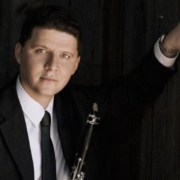
Clarinetist Alexander Fiterstein took a minute out of his busy schedule to answer a few questions for us about the clarinet and our November 1, 2026 concert: “Saluting the Clarinet—Mozart, Beethoven, Bartók and Gershwin.” Tickets at cewm.org.
Q. The clarinet can sound intimate and vulnerable one moment, then wildly theatrical the next. Which part of its personality feels closest to your own?
A. That’s a great observation about the clarinet! I would say that I really enjoy the wide variety of sounds the clarinet can produce and in a way the intimate moments sound more intimate when they follow a wild moment and the other way around as well.
Q. Benny Goodman asked Bartók to write Contrastsfor him and Joseph Szigeti. When you play the piece, where do you most strongly feel Goodman—the jazz musician and virtuoso—lurking inside Bartók’s writing?
A. Benny Goodman was a great Jazz clarinetist but also a connoisseur of classical clarinet. He really valued the classical repertoire and because of his interest in classical music we have the great “Contrasts” by Bartok as well as the Copland clarinet concerto which he also commissioned. I mostly feel Goodman in the clarinet cadenza at the end of the first movement. It sounds like a true improvisation and the peak of the cadenza has a very high note that I believe calls for some vibrato in the style of a band leader such as Benny Goodman.
Q. Mozart knew exactly what his friend Anton Stadler could do on the clarinet when he wrote the Clarinet Quintet. Does playing it ever feel like stepping into a musical conversation that began between those two men more than two centuries ago?
A. Yes, thanks to Mozart’s friendship with Stadler we have the quintet and the wonderful clarinet concerto as well. Playing it feels like Mozart understands the clarinet so well, it feels extremely natural to play this piece. I can sense his affinity to the instrument and to Stadler while playing it.
Q. Mozart and Bartók ask almost completely different things of a clarinetist. Is there something you have to change—in your sound, your instincts, even your personality—when you move from one to the other?
A. Yes, the two works are so different from one another. The Bartok work has a huge range of dynamics and moods, I have to think about how to bring out these moods in order for the piece to come to life. It can feel modern and on edge at times. The cadenza at the end of the first movement is a whirlwind and the tempo of the 3rd movement is very fast!
The Mozart quintet is more about refinement, balance and a sublime conversation between the five players. It has excitement as well but it’s delivered in a different way. Both are masterpieces, written at a different time and place.
About Alexander Fiterstein
Alexander Fiterstein is recognized as one of today’s most exceptional clarinetists. He has performed in recital, with distinguished orchestras, and with chamber music ensembles throughout the world. He won first prize at the Carl Nielsen International Clarinet Competition and received the prestigious Avery Fisher Career Grant Award. The Washington Post has described his playing as “dazzling in its spectrum of colors, agility, and range. Every sound he makes is finely measured without inhibiting expressiveness” and The New York Times described him as “a clarinetist with a warm tone and powerful technique.”
Performances in the 2025-26 season include concerts with the New York Philharmonic String Quartet, Alaria Chamber Ensemble at Weill Hall in Carnegie Hall, Lincoln Center Chamber Music Society, Palm Beach Chamber Music Society, a solo recital in Beijing, and performances as soloist in the string orchestra version of Osvaldo Golijov’s “The Dreams and Prayers of Isaac the Blind” with the Chamber Orchestra of the Triangle (NC).