
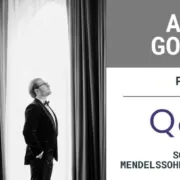
“On the Wings of Song,” a deeply Romantic program exploring love, longing, and the redemptive power of beauty, takes place on Sunday, April 19th, 2026, 4:00 PM at the Mahaiwe Performing Arts Center in Great Barrington. Get your tickets!
In the meantime, enjoy this Q & A with internationally-acclaimed pianist Adam Golka. (Bio here.)
Q. Dichterliebe gets called a love story, but it ends somewhere much darker. Do you hear it as a true arc, or more like a series of emotional fractures that never quite resolve?
A. In a way, it’s a love story without the story: each song is a different universe, a different emotional world, a different state of mind, and we are left trying to deduce what actually happens from the countless hints in the poetry. The miracle of the piece is that the emotional poignancy of each song and text, even when some songs are extremely short, is so consuming that the cycle feels like an entire lifetime. The piece is an ultimate illusion of the perception of time. There’s really nothing quite like it. It’s the sort of thing that some Mahler symphonies accomplish but take two or three times as long and 100 more people to play them in doing so.
Of course, the songs get darker and more despondent in general, but I think the final piano postlude can be interpreted in myriad ways. We heard the same music about halfway through the cycle, where it had a very different significance. Since the last song is about finally burying our pain, maybe it’s an attempt to move on, to acceptance. It’s quite open-ended. Each audience member may hear it differently based on their own experience. It could be redemption, it could be resignation, it could be new life, it could be death.
Q. The piano often seems to be telling truths the voice can’t—especially in the postludes. Do you think of it as a second character, or something more internal?
A. That’s a beautiful way of putting it, and I think that it is sometimes very true. However, the piano’s role is multifaceted. Sometimes the piano conjures the general universe of the text as Schumann felt it. Sometimes it paints the details of text. Sometimes it comments on the text, befriends the text, or observes the text with detachment. At other times the piano runs away in anger or dreams from the text.
Q. There’s an intensity in this piece that never tips into display. How do you handle that tension between restraint and release?
A. I think the music in the text naturally leads us through that process. If we are deeply attuned to the subtleties of the music and text, it keeps us close to the inner world of this piece and away from misjudging its effect. Anything too extroverted would make it theatrical, which I don’t believe it is.
Q. There’s an intensity in this piece that never tips into display. How do you handle that tension between restraint and release?
A. I think the music in the text naturally leads us through that process. If we are deeply attuned to the subtleties of the music and text, it keeps us close to the inner world of this piece and away from misjudging its effect. Anything too extroverted would make it theatrical, which I don’t believe it is.
Q. Pairing this Schumann work with Mendelssohn feels almost provocative—ambiguity next to clarity. Do you experience it that way, or is that too neat?
A. Well certainly Mendelssohn is a different world because he was ultimately a very “classical” romantic. But the bond between them was strong, one of Robert and Clara’s children was even named Felix! I think it’s a beautiful pairing because while much of Mendelssohn’s Trio is highly dramatic, it is not a tragic piece—in fact it is largely uplifting and offers solace next to the unrelenting heartbreak of Dichterliebe.
Q. Romanticism often gets flattened into “big feeling,” but here there’s just as much concealment—irony, coded emotion, self-protection. Is that part of how you approach this program?
A. I think feelings are infinite. If we play something with “big feeling” in a similar way for a long time, it loses its meaning. Which is not to say that we should hold back! I think Schumann and Heine give us all the clues we need to discover something about the unique world of feelings in each individual song.
Q. Schumann can either cohere or feel like it’s constantly slipping out of your hands. Do you lean toward structure, or toward letting that instability speak?
A. Perhaps a little bit of both?
Q. That final postlude—no voice, just the piano carrying everything that’s left unsaid. What’s happening there for you?
A. It’s different every day, each time… I try to play it as a reaction to what just happened leading up to it in a live performance, to how I feel at that moment. Moreover, I think it’s up to each individual audience member to interpret it as they feel it as well!
Q. After living with this piece, is there still a moment that catches you off guard?
A. Honestly, every moment catches me off guard! Just playing the first two notes—the solitary right hand note which becomes a dissonance as soon as the left hand follows—gives me goosebumps. I fell madly in love with this piece when I was 14 years old, and it still fills me with wonder from start to finish; it doesn’t have a moment of waning inspiration. It’s the kind of piece that makes life a beautiful thing.
Get all the details and buy tickets for this performance today!